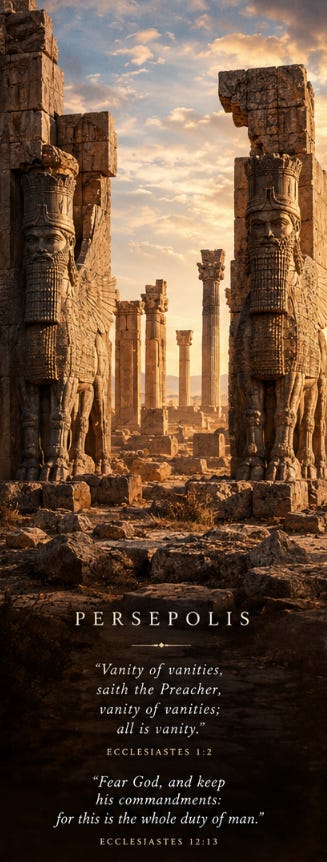
I just read this post on the Wayfare substack by Philip Barlow:

It got me thinking about one of my favorite General Conference talks: Thomas S. Monson’s “Choose You This Day,” from the October 2004 General Conference.
In the talk, President Monson lists three of J. Reuben Clark’s favorite scriptures, two of which come from Ecclesiastes. These come in a moment of ekphrasis that I love. Here’s the section:
Mine was the privilege to know rather intimately President J. Reuben Clark Jr., who served for so many years as a member of the First Presidency. As I assisted him in the preparation for printing his monumental books, priceless lessons were learned. One day while in a somber, reflective mood, President Clark asked if I could arrange for the printing of a picture suitable for framing. The picture was to feature the lions of Persepolis guarding the ruins of a crumbled glory. President Clark wished to have printed with the picture—between the decaying arches of a civilization that was no more—a number of his favorite scriptures, chosen from his vast knowledge of holy writ. I felt you would wish to know his selections. There were three—two from Ecclesiastes and one from the Gospel of John.
First, from Ecclesiastes: “Fear God, and keep his commandments: for this is the whole duty of man.”
Second, “Vanity of vanities, saith the Preacher, vanity of vanities; all is vanity.”
Third, from John: “And this is life eternal, that they might know thee the only true God, and Jesus Christ, whom thou hast sent.”
I assume that the “lions of Persepolis” which President Monson put into President Clark’s picture are the two lamassu at the front of the Gate of All Nations.
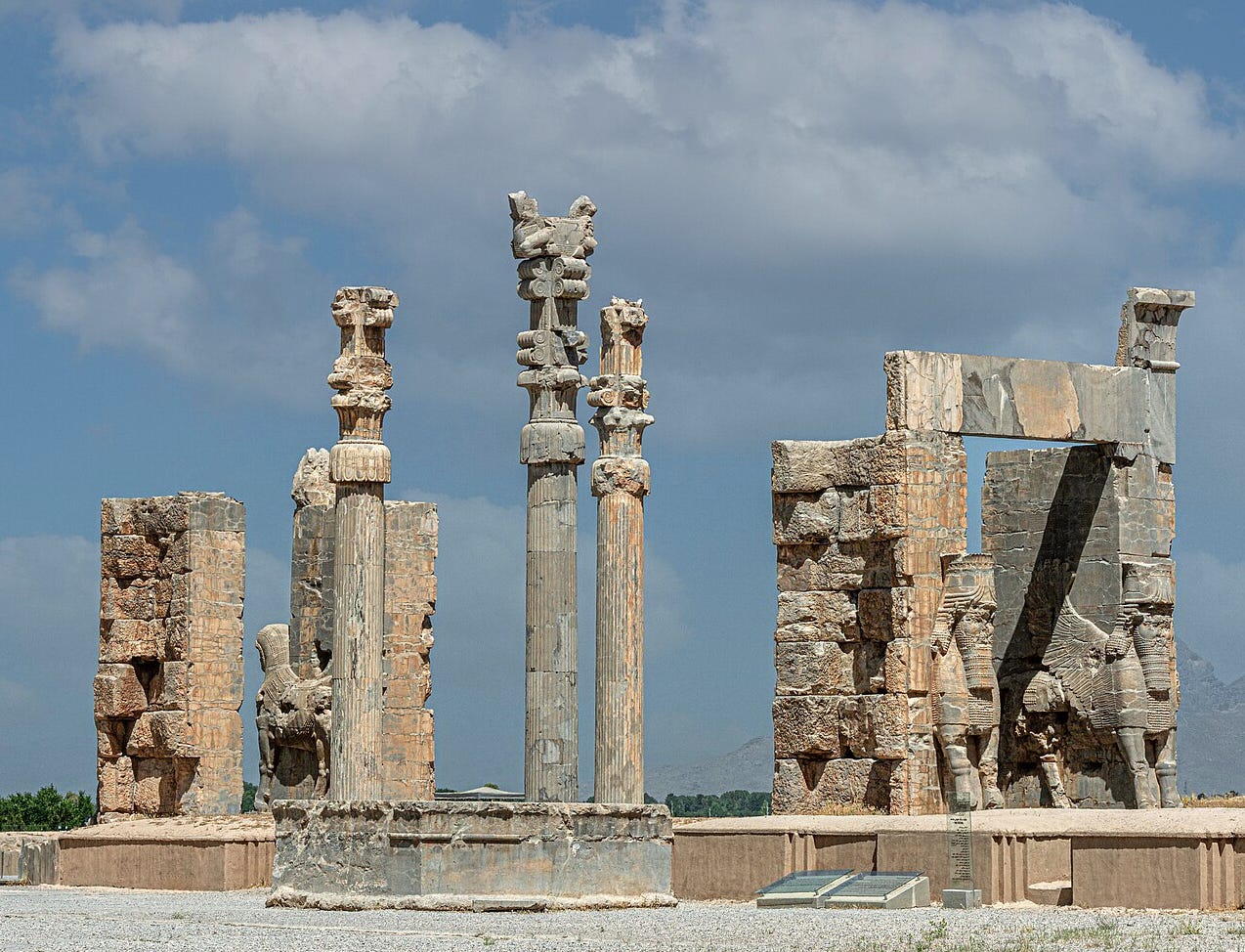
The ruins of a civilization matched with the words of a prophet urging people to fear God, keep his commandments, and to know God and Jesus is, I think wonderful. I love the juxtaposition. It is a scene I love so much I got my own copy of the two ruined lions and have had them hung in my house for years. When I pass them by I try to remind myself, '“fear God, keep his commandments,” and, “This is life eternal, to know God and Jesus Christ.”
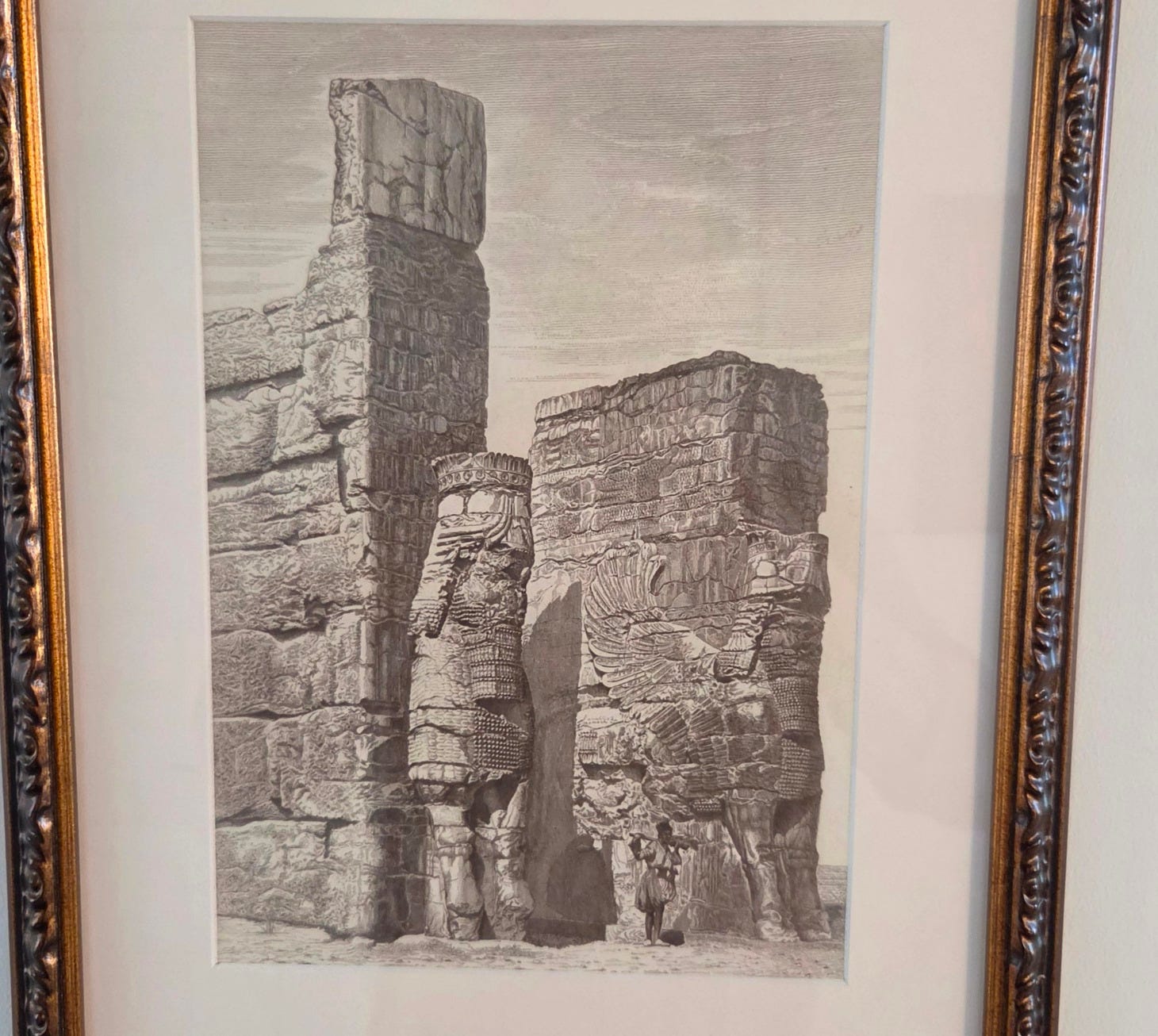
These lamassu here were built during the Achaemenid empire, but it was the Assyrian empire 300 years earlier that first created these large, mythic monuments. The figure of the lamassu is the image on the cover of my book, Neither Fear Ye Their Fear.
It’s situated there so that it appears to be marching down from Assyria, towards Jerusalem. My book cover is based on the description of the lamassu slouching its way towards Bethlehem that W.B. Yeats describes in The Second Coming:
...somewhere in sands of the desert
A shape with lion body and the head of a man,
A gaze blank and pitiless as the sun,
Is moving its slow thighs, while all about it
Reel shadows of the indignant desert birds.
My novel takes place at the point where the terrifying thing is still approaching. Assyria marches to overthrow Judah, and Israel, and Aram. J. Reuben Clark’s picture takes place at the point where the terrifying thing has already become archaeology. It’s defeated. Most no longer remember it.
In this way, J. Reuben Clark’s seems to be a response, or at least informed by, Percy Bysshe Shelley’s Ozymandias. As Shelley described the vast wasteland that laid around the ruins of Ozymandias:
Nothing beside remains. Round the decay
Of that colossal wreck, boundless and bare
The lone and level sands stretch far away.
Is Shelley’s description of the ruins of Ozymandias not the J. Reuben Clark image? But, what is the difference? J. Reuben Clark adds a silver lining. He does not leave it at nihilism. He does not leave it at simply “vanity of vanities.” He adds a way out. He provides an off ramp. A higher way: fear god, and keep his commandments. Obtain eternal life. Know God and Jesus Christ.